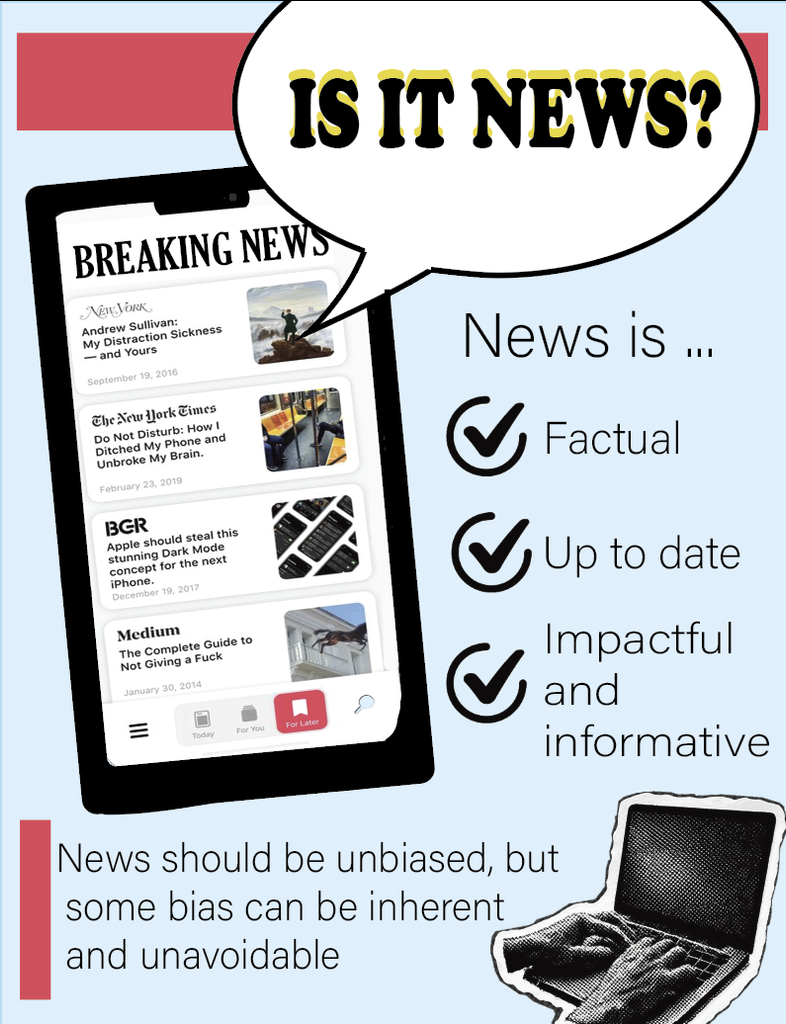
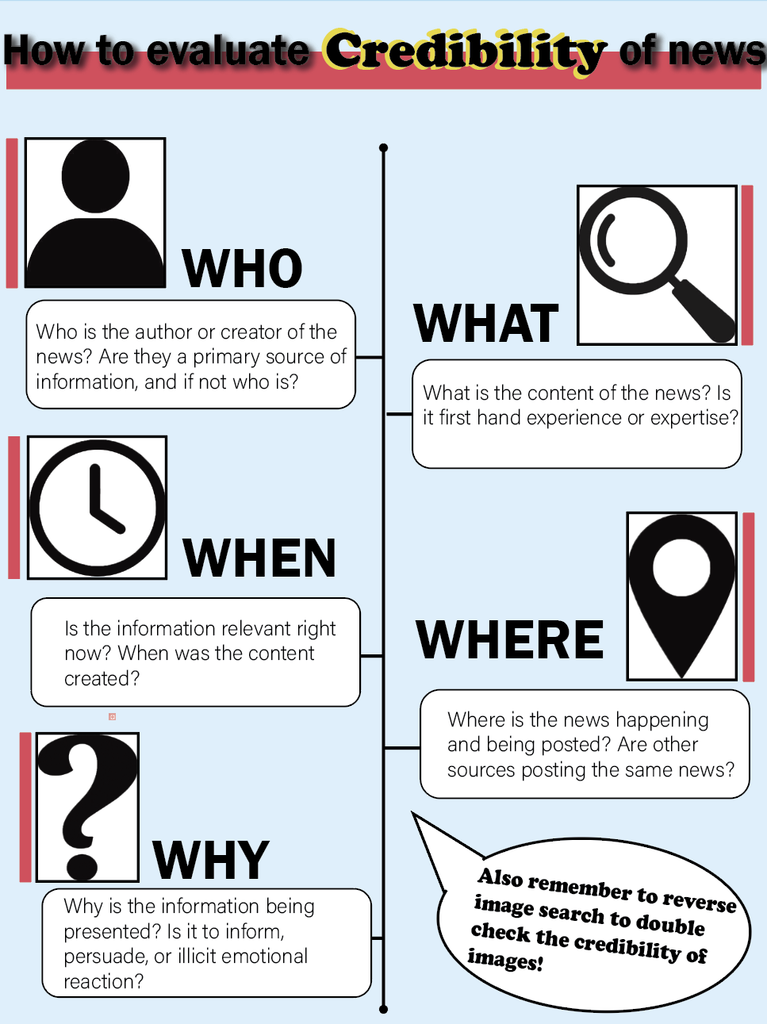
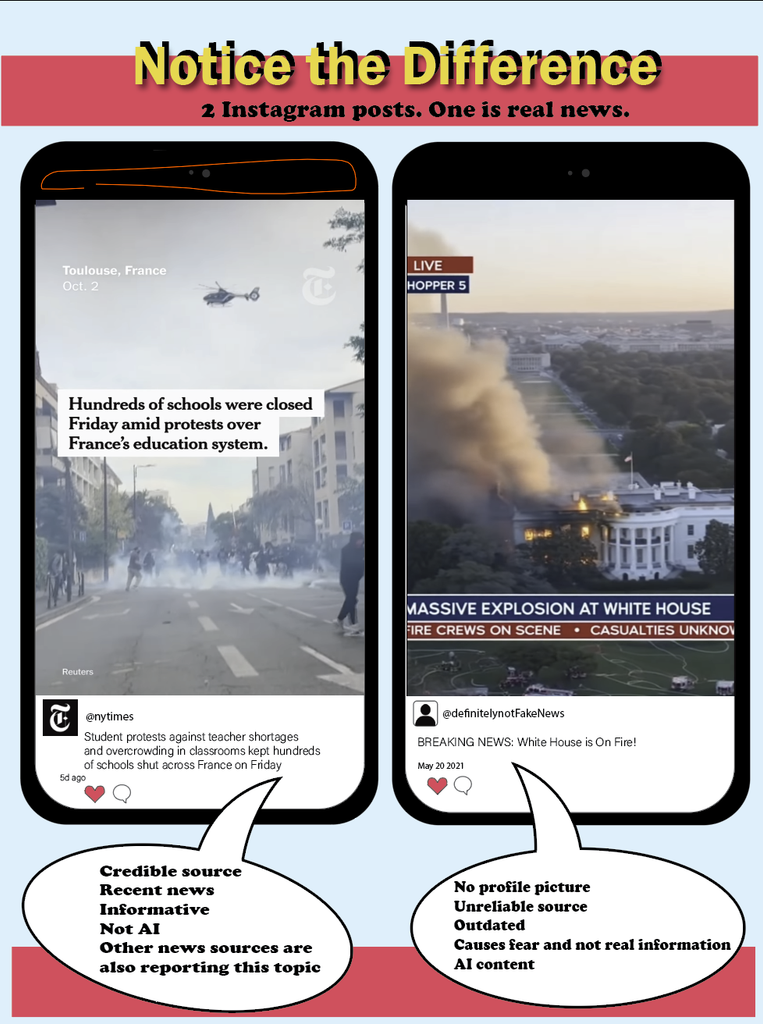
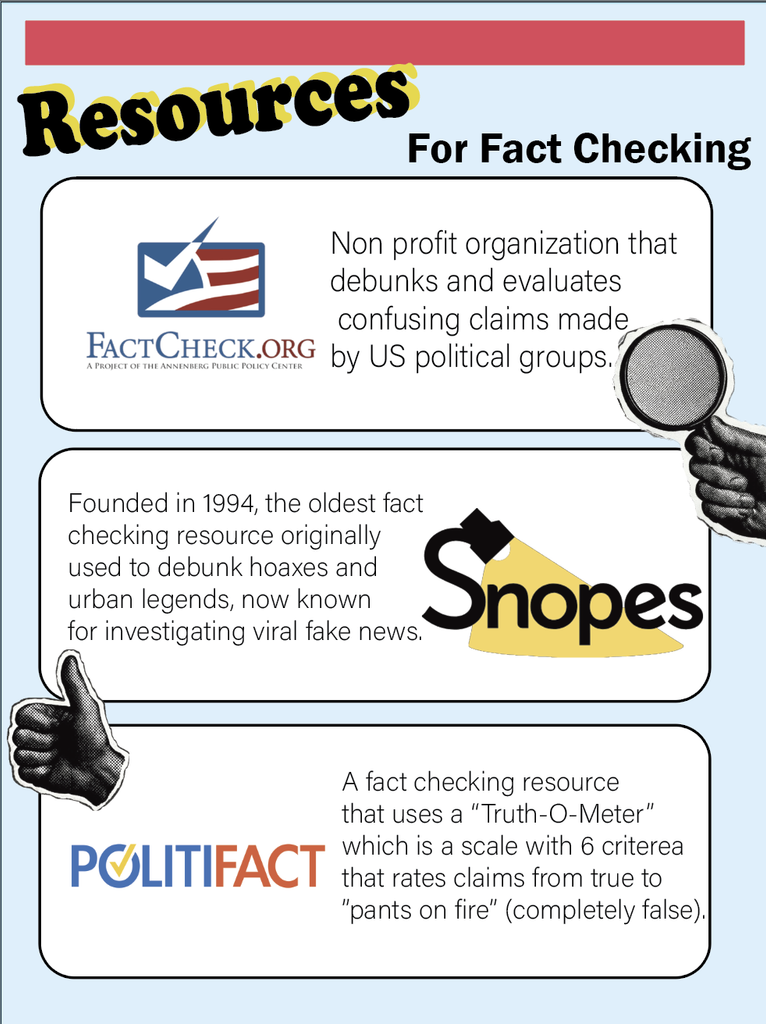
For my final creativity project I decided to make infographics.
The infographics evaluate the credibility of news and news sources. I think this topic is important because a lot of people get their news from social media and don’t take a look at who is posting the news, or what the messaging is behind a post. I was inspired by the Rumor Guard from the News Literacy Project on debunking fake news articles. In my opinion being able to spot actual credible news and finding credible sources is the first step to staying aware of misinformation. The project will target my creation towards users who may be more chronically online: middle schoolers to high schoolers.
One way that instagram has historically done this is through fact checkers. Before 2025, Meta, the company that owns Instagram and Facebook, used third party fact checkers which utilized independent experts. These fact checkers would rate content with these specified ratings, “False, Altered, Partly False, Missing Context, Satire, and True.” Meta also uses technology (automated systems) that scan content for policy breaches. Recently Meta discontinued the use of independent fact checkers. According to a Meta news article, these independent fact checkers became too biased about legitimate content and “became a tool to censor.”
This makes me wonder if the safeguarding of misinformation censors the right to free speech?
A judge barred “all communication by the Biden administration with social media platforms” in 2023. The judge listed “ 22 occasions where White House staff pressured social media companies.” This decision came about after the 2022 court case against former president Biden for “suppressing free speech regarding Covid-19.” Some would consider it is up to the private entity to determine what is banned or labeled as misinformation, therefore not censorship. Then again if it is government agencies pressuring platforms this can be seen as censorship.
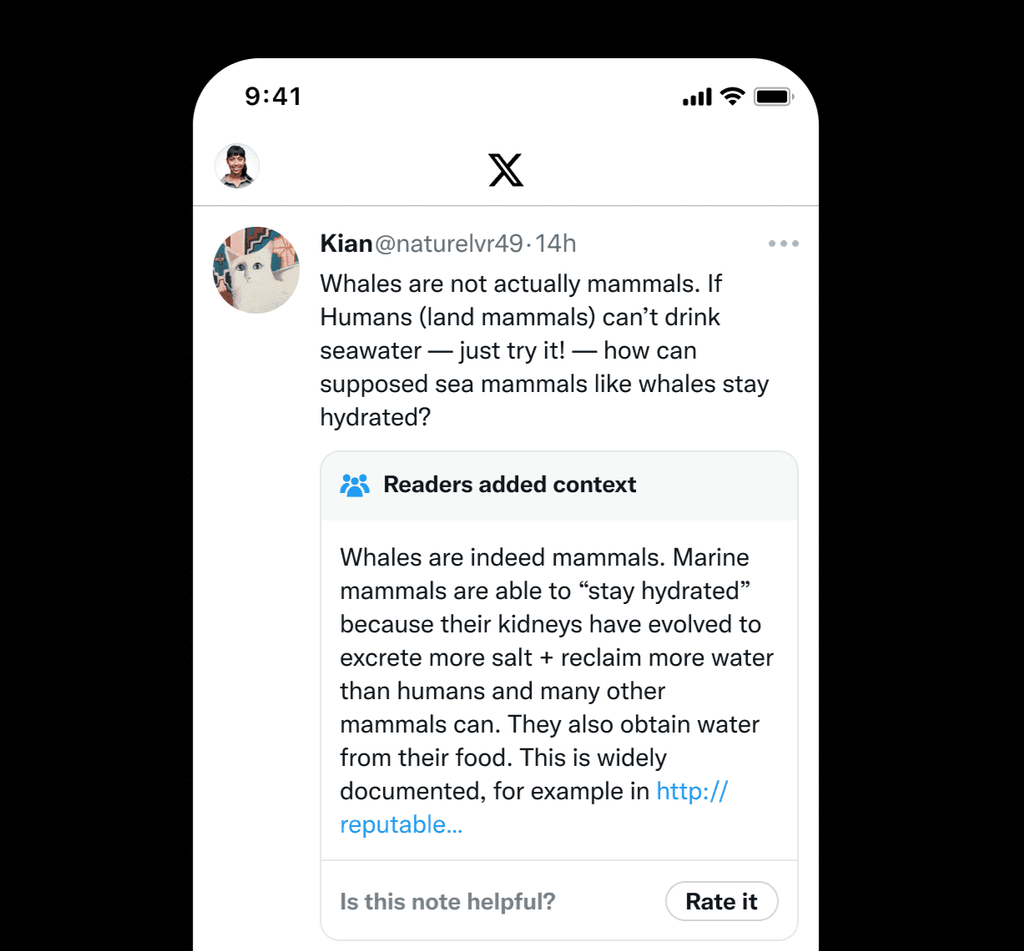
Anyways, to combat this Instagram came up with the Community Notes solution. This approach is also used by Twitter. Basically this allows “contributors” or regular people on twitter to add context to misleading posts. On Twitter these community notes are visible to the public and “open source” so anyone can audit, analyze or suggest improvements. Twitter and Meta are unable to edit or change the notes, which makes these corrections less biased by the site itself. I find this pretty cool, like the company really cares about genuine findings and isn’t just covering up unwanted posts/ content.
Example of Note on Twitter:
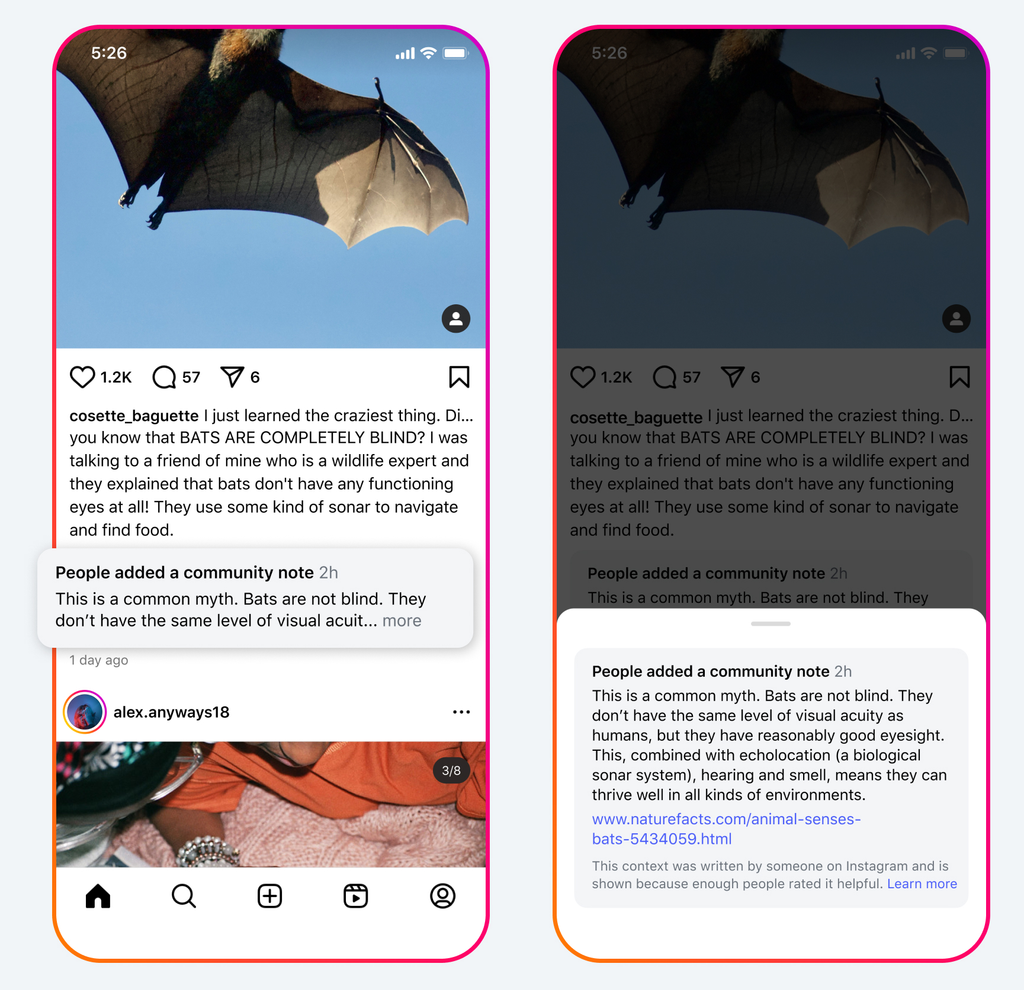
This is pretty much the same method that is used now by Meta.
Example of Instagram Note:
They will also still implement their automated systems which previously, “resulted in too many mistakes and too much content being censored.” Now these will be used for “tackling illegal and high-severity violations, like terrorism, child sexual exploitation, drugs, fraud and scams.”
Another main policy detail listed on Meta is what types of misinformation is removed outright on the app. These criteria include: physical harm or violence, harmful health misinformation, voter or census interference. Manipulated media is also listed as a criteria that undergoes scrutiny. (Which I believe will become even harder to determine or govern with the growth of AI).
With this I also looked up Instagram’s AI policy, which does have a quite extensive list of images that are not allowed including living people other than oneself without permission, fictional characters without copyright permission, religious figures, murderers, hate groups, government entities etc..
Although Meta also prohibits imagery depicting nudity, violence, etc, many recent articles within the past 2 weeks (Wired, Futurism) claim that across Meta apps ads were displaying child exploitation and abuse. These ads also used images of real children, in one case using imagery of a child from a European royal family. Reportedly, these ads came out prior to Meta’s launch of an AI tool for detecting and blocking harmful ads.
With this information, Meta seemingly needs work on their AI detectors as well as monitoring what type of imagery is being posted online. Using AI to detect other AI is an interesting concept, and seemingly would help catch the swaths of unwanted content that are no doubt posted every second of every day. (literally billions of people posting content daily)
According to Security.org, “42% of Facebook users report encountering misleading or false information regularly” and 35% of TikTok users claim the same thing. (to make my point about the insane amounts of misinformation)
Anyways, I believe the Community Notes approach will prove to be a helpful and successful tool for safeguarding against misinformation. As we have learned, cognitive science shows that collaboration and “groups that incorporate diversity of thought – are essential for improving our ability to solve problems and find solutions.”
In summary I believe stopping the spread of all misinformation on social media is impossible, but the lengths at which Meta is going about stopping the spread is, in the least, somewhat hopeful.
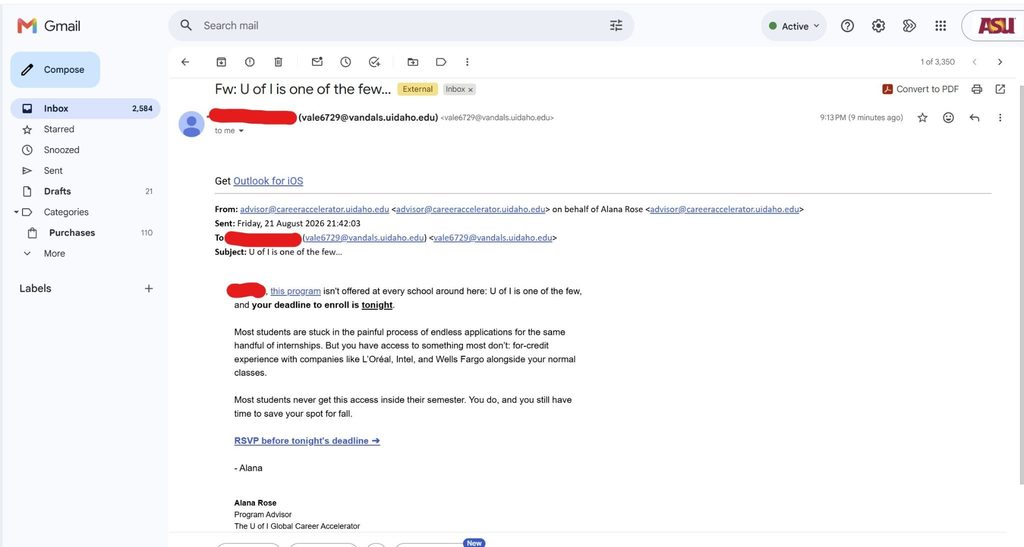
This claim is not from an article or social media post, but rather it is a claim that I have declared. I have been wondering about this certain profile for a long time and thought that I was onto something. Through my school, I would receive emails from Alana Rose and Carla Martin. Both claimed to be “Program Advisor” for The ASU Global Career Accelerator. I was not wary of these emails until my boyfriend who is enrolled at University of Idaho told me the name looked familiar. We checked his emails too and alas, the same two Program Directors were plaguing his emails as well announcing the same opportunities. Immediately I assumed they were AI.
Here is a screen shot of my latest email from Alana and his. Both have the same subject.
After reading the Verification Handbook and seeing how researchers investigate profiles and learning about bots, I wanted to try it out.
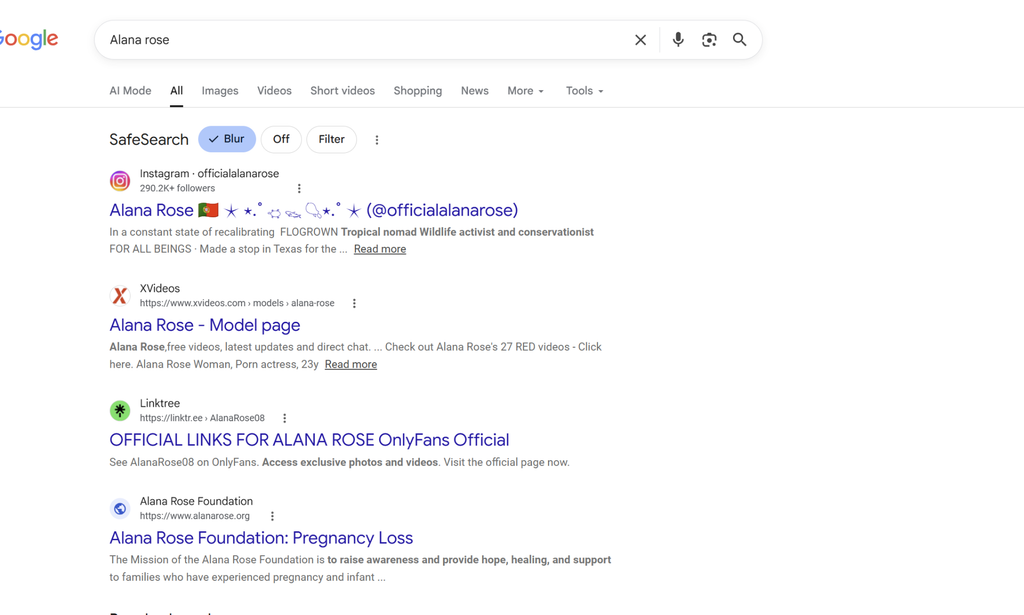
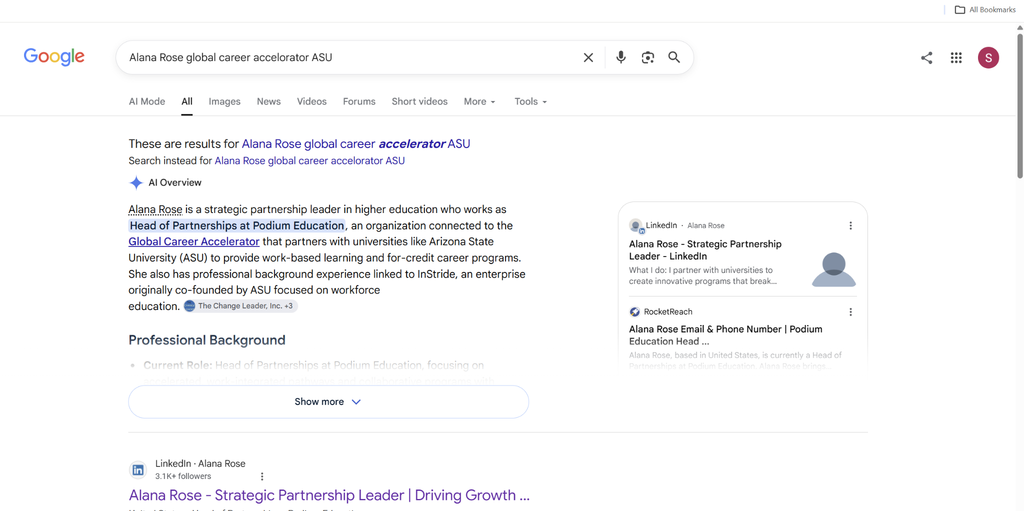
To start my investigation I typed Alana Rose into google. This is what unfortunately popped up …
Not looking good but then I narrowed the search to : “Alana Rose Global Career Accelerator ASU.” And I seemingly got some answers.
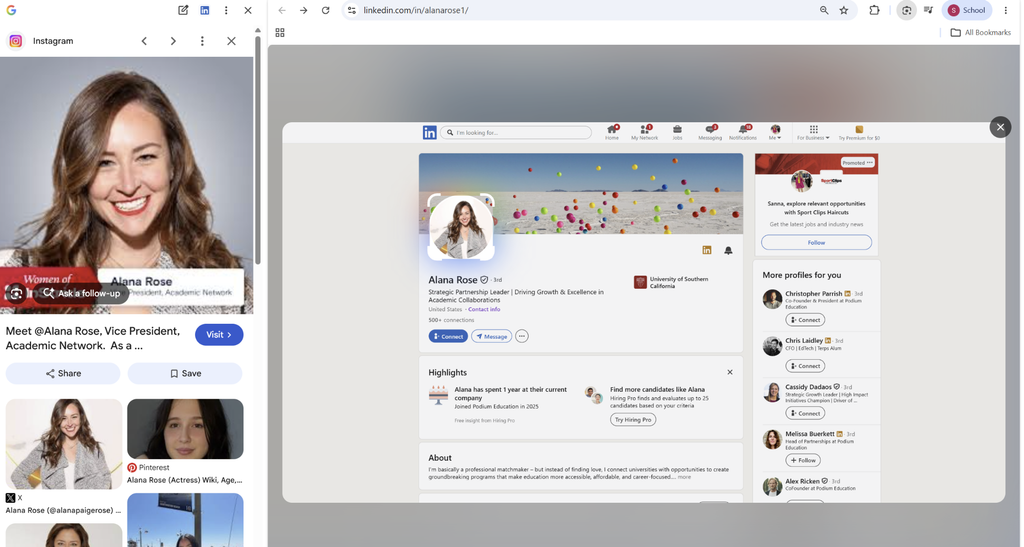
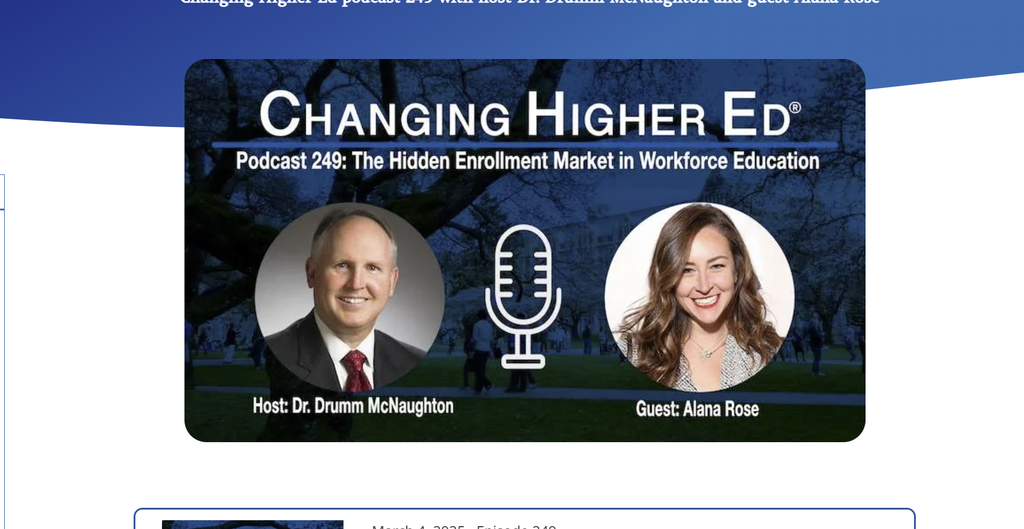
I found her LinkedIn page which was also seemingly legit. I reverse image searched her profile and only got the same pictures. I found an instagram post from a company she used to work for (said so in her LinkedIn profile). Was a bit sketchy because it was the last post on this instagram account from 2023 and there were 50 likes and no comments in an account with just over 1,100 followers. Her in-link instagram profile gave an error page and her Twitter account had the same profile picture. She also solely seemed to post about getting votes for her daughter’s baby of the year campaign. The website RocketReach also provided the same information as well as a list of partial phone numbers (which I needed to pay to obtain). This was also a bit fishy because in one of her emails to my boyfriend’s school account she listed a number that was a local number, yet not one listed on the Rocket Reach website.
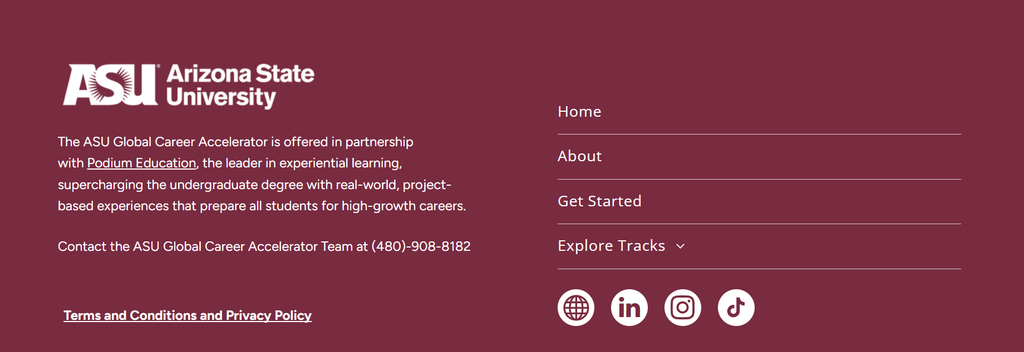
Alana Rose now works for Podium Education which is listed on the ASU website on the Global Career Accelerator. Likewise, ASU’s Noah Rost Executive Director of Global Education is listed on the Podium Education website.
Another piece of evidence that does not support my claim is the fact that all of the emails sent to me were random. There wasn’t a pattern with times or dates that made her seem like a bot. The messages seem automated because they only differ in wording slightly. I still wouldn’t be surprised if Alana was a cyborg, only half controlling the email account.
I had not researched as far with Carla Martin, but she also works for Podium Education, the information of which I found on her LinkedIn.
It is important to validate claims to stop the spread of misinformation. The truth is always an important thing to investigate. And it so happens that a claim that you think is true may turn out to be false.
In this blog post I will be going over different tools used to educate individuals about misinformation.
The first website that I spent some time looking at was, News Literacy Project’s Rumor Guard. The News Literacy project is a non profit organization designed to teach students about online misinformation. They have a digital learning platform called “Checkology” which offers free courses. The Rumor Guard website looks at news headlines and viral content and analyzes the content based off of the 5 factors: Is it authentic, has it been posted or confirmed by a credible source, is there evidence that proves the claim, is the context accurate?, and is it based on solid reasoning? Using the factors, Rumor Guard debunks some pretty believable headlines and even images and videos on their “Recent Checks” page.
The first post on this page is from September 3rd titled, “AI videos depict extreme police takedowns in London. Carefully observing and checking the details of the video prove the content to be AI generated.
Wait, what if I can’t tell that a video is AI by just observing?
I wouldn’t always trust my judgment in noticing AI content. So I did some research and there are websites such as hivemoderation.com which detect and moderate AI. Even asking a regular AI like ChatGPT to analyze content could work too. Hive moderation is a paid tool created by Hive AI that companies and brands can use to moderate their content, apps, etc. Just to make sure this isn’t fake news and Hive AI is a reliable source for detecting AI content, I did some research and found some pretty good reviews. One from Undetectable AI Blog. This overview of Hive AI moderation and detection was written by Christian Perry the CEO of Undetectable AI which was ranked best AI detector by Forbes.
Anyways, Rumor Guard seems pretty cool in discovering fake news stories and giving tools to help find fake news on my own.
Next Up ..
I played Bad News, an educational game where I play as a troll online and try to make up as much fake news as I can, gain a good credibility rating, and an astonomical amounts of followers. At the end of the game I had 17K followers! (I’m so evil) In the process I learned about consiratorial media, fabrication, and detecting false news headlines.
How much media do I consume in a day? & How much questionable content do I come across?
To be completely honest I do not consume that much media. Which I understand is off brand as a Gen Z person, considering the average American spends over five hours a day on their phones, with Generation Z spending upwards of six and a half hours. Last week from August 16-23, my average screen time was 2 hours and 7 minutes. Considering this, it was quite simple to piece together the few times I picked up my phone or opened my laptop. I am also choosing to include times from yesterday for more data.
August 30th
9:00am
I woke up realizing I had to turn in this assignment so I figured checking my email for news updates would be a good start. I don’t subscribe to many news platforms. Other than LinkedIn sending me one trillion spam jobs, I accidentally signed up for New York Times. At this time I did not actually open any of the articles, but simply looked at the headlines:
These three headlines sparked my curiosity and led me to believe that the New York Times is probably biased and evidently left leaning. Later at work I talked with a coworker and had a good laugh about Lake America. I went back to NYTimes and actually read the full article.
9:30 am
Switched over to youtube after making my coffee to watch and follow along to a work out video.
8:00 pm
Got out of work around 6:30 and got home a bit after 7 because I stopped by the grocery store. I decided to listen to my favorite podcast while cutting up the watermelon and honey dew that I just purchased and while making dinner. The podcast is a true crime comedy podcast and I listened while the host told me about “‘Witch Doctor’ murderer Mona Fandey.” Went online after listening to check out some sources that were used. A list of 30 sources, wow these gals really do their research!
Did some brand research for a group project I am working on in my fashion communication strategies class. We are to chose a brand, do research, and create a PR opportunity surrounding the brand. Our brand is Magnolia Pearl and these are some articles I found interesting and helpful to my reasearch:
This article is from New York Times (my favorite site apparently lol) The author is much easier to find out about, which makes this source seem more credible.
10:00pm
This is when I got back from work and was finally settling down. Got sent a youtube short from my boyfriend who definitely just wanted to push my buttons: Males are the Beautiful Gender.
Which yea, absolutely disinformation and fake news, period.
Apprarently scientifically based on the fact that female animal species are usually the plainer less beautiful counterparts to the males. Think peacocks or ducks. Posted by a “youtube personailty” and twitch streamer. Super official. (I am being sarcastic)
Anyways,that was the two days worth of media I have consumed. Other than New York Times being slightly partisan (as newspapers have always been) and the silly youtube short I watched. I have not come across any jarring misinformation or disinformation. It was interesting to analyze the sources and get a deeper dive into the media I have consumed.